Step-by-step guide
Florida Non-Resident Guide
How to apply for a Florida non-resident concealed weapon license.
Where You Can Carry — See the Map
Most likely has the most reciprocity states, and is relatively easy and quick. You can apply online.
What You Need
Your valid driver's license.
Your CERTIFICATE OF COMPLETION from a firearms training class or other document that evidences your competency with a firearm. Your training must include live fire using a firearm and ammunition.
A digital, passport-style photo taken within the last 30 days.
A fingerprint card filled out by your local police department (see Step 3).
Step 1: Apply Online
Apply on the FDACS online licensing website.
Open the Florida Application WebsiteStep 2: Pay the Fee
Total cost of $97.00: $55 for the license plus $42 for fingerprint processing (FDACS fee sheet). Out-of-state applicants pay the $42 with the mailed fingerprint card (see below).
Make sure you do not pay the $42 twice: if the online checkout already charges a fingerprint processing fee, do not send a second $42, and check the amount on your online receipt before you mail the card. (A credit card adds a 2.5% processing fee and a $0.50 E-Check fee online.)
Step 3: Mail Your Fingerprint Card
Non-Residents must mail in their Original Fingerprint Card to the Division of Licensing. Any local Police Department can fill it out for you. Electronic fingerprint copies are not accepted: your prints must be taken by a law enforcement agency on the original card.
Request a Blank Fingerprint CardMail the completed original fingerprint card (use Priority Mail with Return Receipt) with a check or money order in the amount of $42 to:
Florida Department of Agriculture and Consumer Services
Division of Licensing
Post Office Box 6687
Tallahassee, FL 32314-6687
Sources: FDACS fingerprint instructions (laso.fdacs.gov/documents/LASO_FP_Instructions.pdf) and the FDACS fee sheet.
Step 4: Wait for Your License
It usually takes 4-6 weeks to get your decision and, hopefully, your permit. By law, FDACS has up to 90 days from the day it receives a complete application to issue or deny it, and it says most licenses are issued well before that.
It is valid for 7 years with an easy renewal process.
Alabama • Alaska • Arizona • Arkansas • Delaware • Georgia • Idaho • Indiana • Iowa • Kansas • Kentucky • Louisiana • Mississippi • Missouri • Montana • Nebraska • Nevada • New Mexico • North Carolina • North Dakota • Ohio • Oklahoma • South Dakota • Tennessee • Texas • Utah • Virginia • West Virginia • Wisconsin • Wyoming
Checked November 1, 2026 against each state's official rules (the same data as the map below). FDACS lists more reciprocity states, but some of them honor only licenses held by Florida residents. Some other states let visitors carry with no permit at all: see the map.
Renewing Your Florida License
Tips from Applicants
Most likely has the most reciprocity states and is relatively easy and quick. Pay attention to the $42 fingerprint fee so you don't pay it twice, and send the card by Priority Mail with Return Receipt so you can track it.
Official Sources
More Out-of-State Permits
More out-of-state permits: step-by-step guides for Arizona, California, Connecticut, Maryland, Massachusetts, Minnesota, Nevada, Pennsylvania, Rhode Island, Texas, Utah, Virginia, Washington DC, Washington State, all compared on Out of State Non-Resident Permits. Visiting a state that gives New Yorkers no permit? See the visitor guides for Colorado, Delaware, Hawaii, Illinois, Michigan, New Mexico, North Carolina, Oregon, Wisconsin.
Where You Can Carry
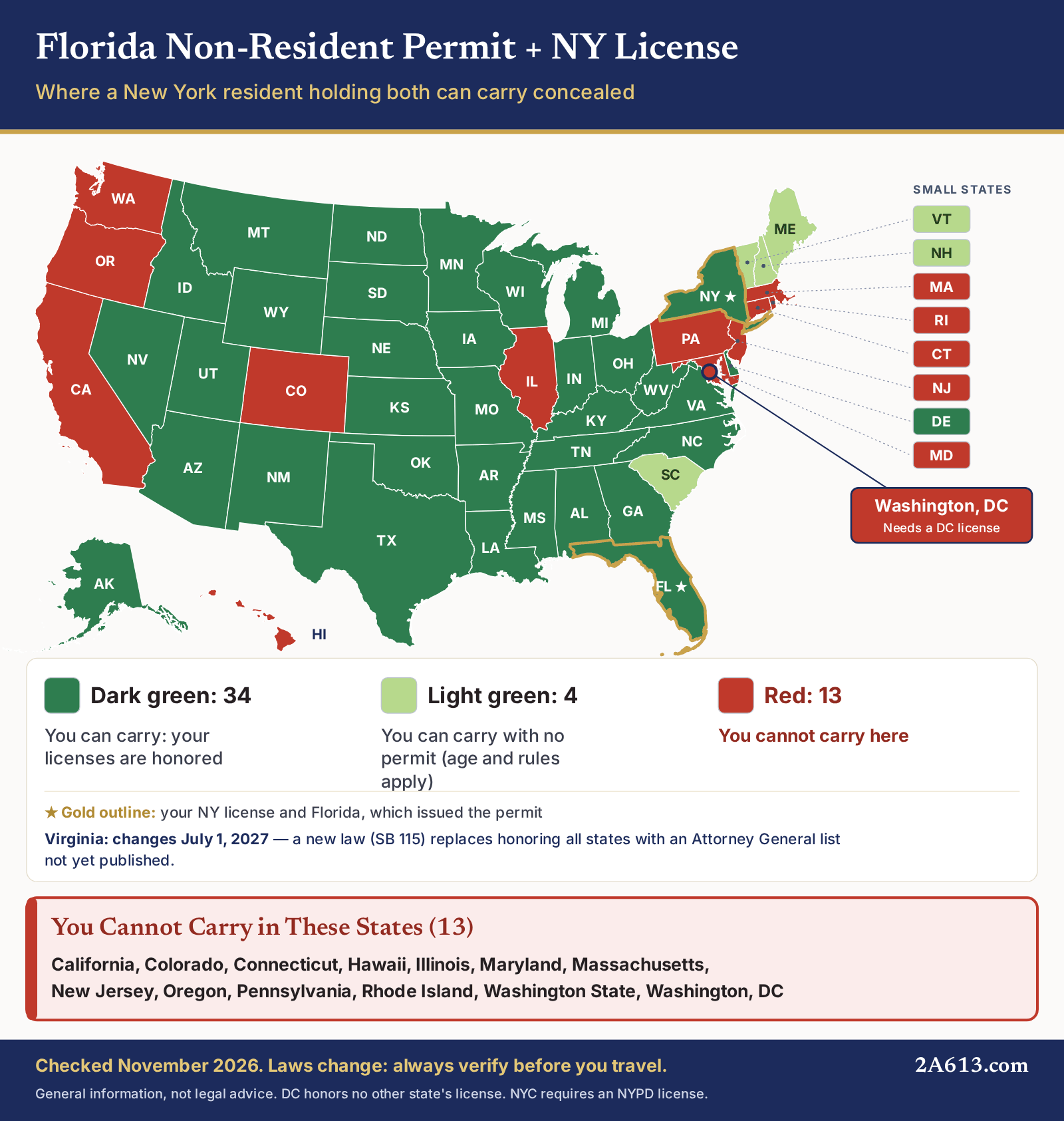
You Cannot Carry in These States (13)
California, Colorado, Connecticut, Hawaii, Illinois, Maryland, Massachusetts, New Jersey, Oregon, Pennsylvania, Rhode Island, Washington State, Washington, DC
Dark green: you can carry. Your licenses are honored there (or it is the state that issued the permit).
Light green: you can carry with no permit. That state lets visitors carry with no permit at all. Age limits and rules apply.
Red: you cannot carry here. None of your licenses is honored there, and visitors may not carry without one. Do not carry.
Washington, DC does not recognize any other state's license — you need a DC Concealed Carry Pistol License.
Virginia: changes July 1, 2027 — a new law (SB 115) replaces honoring all states with an Attorney General list not yet published.
Before You Travel
- Check every state on your route. Read the official state police or attorney general website for each state you will pass through. Laws change, and this map can fall behind.
- Verify your exact permit type is honored. Many states honor only permits issued to residents of the issuing state, not non-resident permits.
- Resident vs. non-resident rules differ. A state may treat the same permit differently depending on where you live.
- Permitless carry has limits. Some permitless-carry states allow it only for their own residents, or only from a certain age.
- Review each state's carry laws. Know where carry is banned (schools, government buildings, bars, parks, transit and more) and the rules for carrying in a car.
- Duty to inform. Some states require you to tell a police officer right away that you are carrying.
- Ammunition. Some states restrict hollow-point ammunition (for example, New Jersey). Check what you may carry.
- Magazine capacity. Magazine limits differ by state.
- Type of firearm. Some places ban certain firearms (for example, AR-style rifles are not allowed in New York City).
- Interstate travel (safe passage). Under federal law, 18 U.S.C. § 926A (part of the Firearm Owners Protection Act of 1986, signed by President Reagan), you may transport a firearm through a state where you cannot legally carry, if you may lawfully possess and carry it at both your starting point and your destination. The firearm must be unloaded, and neither the firearm nor any ammunition may be readily accessible from the passenger compartment: keep them in the trunk, or, in a vehicle without a trunk, in a locked container other than the glove compartment or console. Stops along the way can complicate this protection, so verify before you travel. Read 18 U.S.C. § 926A
Checked November 2026. Laws change: always verify before you travel. This is general information, not legal advice.
New to the terms? See the 2A Glossary.

You Carry the Responsibility. We Carry the Process.
The decision to carry is yours. The stress of getting approved doesn't have to be. White Glove is a full service: we handle the process with you, make sure every requirement is met 100%, and stay with you to the finish line. Every completed application we've handled has been approved.
- Full service - we take the stress of doing it all
- Every requirement checked and met, 100%
- We Prepare and Submit All Your Paperwork
- Notary services available*
- Your 18-hour training scheduled
- We Prep You for the Fingerprinting and Interview Appointment
- Guided step by step - and We Assist You Once You're Approved
Join the 2A613 Community
Take our community survey and subscribe to updates. We only email about important topics and never sell your email to third parties.
Take the survey