Visitor guide
Hawaii Visitor Guide
What a New York carry license holder can and cannot do with a handgun when visiting Hawaii.
Where You Can Carry — See the Map
Hawaii Does Not Honor Any Other State's License and Gives Carry Licenses Only to Hawaii Residents. A Visitor May Bring a Handgun Only to Keep It Unloaded and Cased, and Must Register It Within 5 Days.
At a glance (checked Nov 1, 2026):
Can a New Yorker get a permit? No. Residents only (confirmed). Since 2024 state law (Act 52) requires a Hawaii carry license applicant to be "a resident of the State." This applies in all four counties
Does Hawaii honor a NY license? No. Hawaii honors no other state's license
Non-resident permits (FL, UT, AZ, PA, CT)? No. None are honored
Permitless carry for visitors? No. Open or concealed carry needs a Hawaii license
Carry in a car without a permit? No. A loaded gun in a car is a felony. Only unloaded, in a closed container, between allowed places
Registration: any gun brought into Hawaii must be registered and inspected by the county police within 5 days
Magazine limit: 10 rounds for detachable pistol magazines
Duty to inform: Yes, for license holders: tell the officer immediately when stopped
Can a Visitor Get a Permit?
Hawaii law (HRS § 134-9, as rewritten by Act 52 of 2023, in force January 1, 2024) says the county police chief shall grant a concealed carry license only if the applicant, among other things, "Is a resident of the State" and is 21 or older. For more information click here
This is a state law, so it binds all four county police departments: Honolulu, Hawaii County (Big Island), Maui and Kauai. We checked each county's official page on November 1, 2026:
Maui: its license page lists "Be a resident of the State of Hawaii" as a requirement. For more information click here
Honolulu: applicants need a Hawaii firearm registration for each gun, Hawaii-verified instructor affidavits and a $150 fee. The page does not offer a visitor or non-resident license. For more information click here
Hawaii County (Big Island) and Kauai: applications require a State of Hawaii firearm registration for the gun to be carried and a Hawaii-verified instructor. Neither offers a visitor or non-resident license. For more information click here
Bottom line: no Hawaii county can issue a carry license to a New York resident.
Which Out-of-State Permits Hawaii Honors
Hawaii has no reciprocity. It does not honor a New York license or any other state's permit, resident or non-resident. A Hawaii license is "valid within the State of Hawaii" and is the only one that counts there. For more information click here
Federal LEOSA credentials (qualified current and retired law enforcement officers) are the only out-of-state carry recognized in Hawaii's carry law.
Bringing a Gun and Carrying in a Vehicle
Register first: "Every resident or other person arriving in the State" who brings a firearm must register it and have it physically inspected by the county police within 5 days of arrival (of you or the gun, whichever is later), in the county where you are staying (HRS § 134-3). In Honolulu this is done in person at 801 S. Beretania Street; HPD charges a $45 one-time fee for out-of-state applicants. For more information click here
Where it may be: without a Hawaii license, a handgun must stay at your place of business, residence or sojourn (for a visitor, where you are staying). It may be moved only unloaded, in an enclosed container, between those places and allowed places such as a target range, a gun dealer, a repair shop, a firearms show, a police station or a training class (HRS § 134-25).
Loaded in a car: carrying any loaded firearm on a public highway or in a vehicle without a Hawaii license is a class B felony, and the car can be forfeited (HRS § 134-26).
Leaving it in the car: a gun may not be left in a vehicle out of your control unless it is locked in a safe storage container that is out of sight (Act 52, new section on unattended vehicles). For more information click here
Flying in: follow airline and TSA rules for checked firearms (unloaded, in a locked hard case, declared at check-in). Then register within 5 days.
Federal Safe Passage
Federal safe passage (18 U.S.C. § 926A) protects driving through a state between two places where you may lawfully carry. Hawaii is reached by air and there is no driving through it, so it rarely helps a visitor. For more information click here
It does not let you carry in Hawaii and does not replace Hawaii's 5-day registration rule.
For the flight itself, keep the gun unloaded, locked in a hard case, in checked baggage, and declared to the airline.
Places You Cannot Carry Even with a Permit
Even Hawaii license holders may not carry in a long list of places, including adjacent parking areas (HRS § 134-9.1, from Act 52): For more information click here
Government buildings and their grounds; hospitals, clinics and medical offices; jails; bars and restaurants that serve alcohol; stadiums, movie theaters and concert halls; libraries; colleges and universities; schools, preschools, summer camps and child care; beaches, parks, playgrounds and other state or county recreation areas; shelters; polling places; banks; public transit, buses, rail and airports; amusement parks, aquariums, fairs, museums, water parks and zoos; and permitted public gatherings that are posted.
Private property: Hawaii's rule that banned carry on private property open to the public unless the owner gave express consent was struck down by the U.S. Supreme Court on June 25, 2026 (Wolford v. Lopez). Owners can still post or tell you no. For more information click here
Good to Know
Magazines: detachable pistol magazines that hold more than 10 rounds are banned (HRS § 134-8). Hawaii also bans "assault pistols."
Duty to inform: a person carrying a firearm who is stopped by police "shall immediately disclose" it, and must carry the license, photo ID and proof of registration (Act 52, duty to disclose). For more information click here
Buying in Hawaii needs a county permit to acquire, applied for in person, with a 14-day waiting period. For more information click here
Counties may add their own rules where state law allows. Check the county police page for the island you will visit. For more information click here
Practical advice: for most visitors the simplest choice is to leave the gun at home. If you bring it, plan the registration visit for your first days on the island.
Every state has different laws pertaining to carrying, restrictions etc. It is your responsibility to know these laws and be familiar with them before visiting that state.
This guide summarizes the state's published instructions as of November 1, 2026 and is not legal advice. Fees, forms and rules change; always check the official page before you travel. Tips from others' experience come from users on the chats; they are personal experiences, not official rules.
Official Sources
Checked November 1, 2026.
Hawaii State Legislature, SB1230 CD1 (Act 52 of 2023): HRS § 134-9 residency requirement, sensitive places, duty to disclose, vehicle storage. For more information click here
Maui Police Department, License to Carry (must be a resident of the State of Hawaii). For more information click here
Honolulu Police Department, Firearms (registration of guns brought from out of state, license to carry forms, fees). For more information click here
Honolulu Police Department, License to Carry checklist (2026). For more information click here
Hawaii Police Department (Hawaii County), Firearm Services (license to carry, registration within five days). For more information click here
Kauai Police Department, Firearms Section (license to carry, out-of-state firearm registration). For more information click here
Supreme Court of the United States, Wolford v. Lopez, decided June 25, 2026. For more information click here
Federal law, 18 U.S.C. § 926A (safe passage). For more information click here
Where You Can Carry
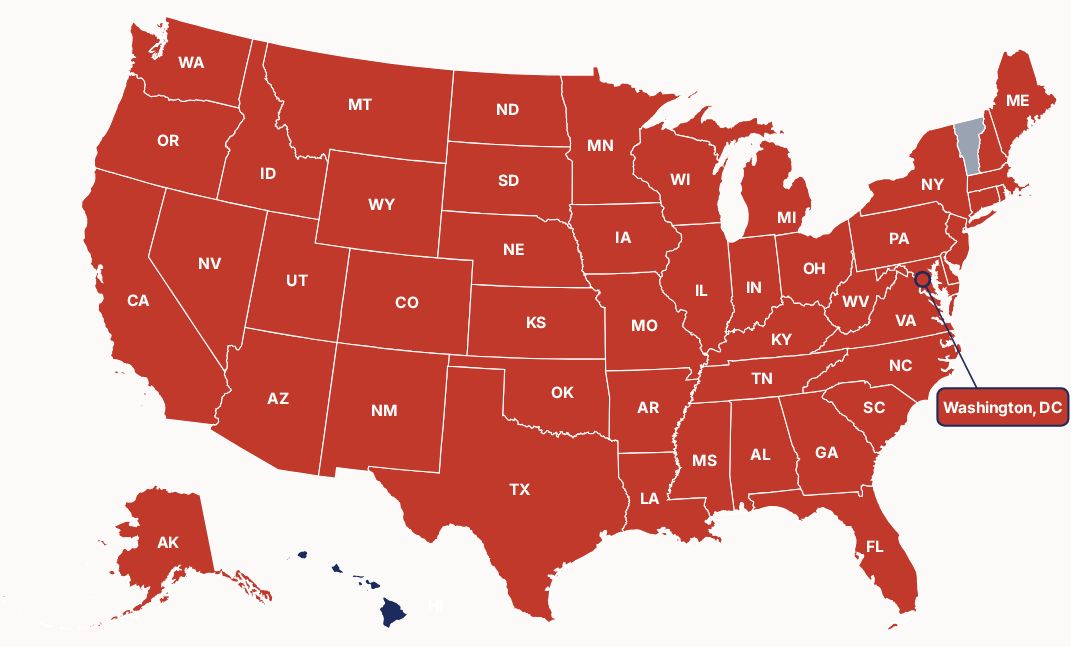
Hawaii Honors Permits from These States (0)
None. Hawaii honors no other state's permit.
Navy: Hawaii. Green: Hawaii honors a resident permit from that state. Red: not honored. Gray: Vermont issues no permits.
A New York license or a non-resident permit is honored here only if this map and the guide above say so. Tap the button below and then any state for the details.
Before You Travel
- Check every state on your route. Read the official state police or attorney general website for each state you will pass through. Laws change, and this map can fall behind.
- Verify your exact permit type is honored. Many states honor only permits issued to residents of the issuing state, not non-resident permits.
- Resident vs. non-resident rules differ. A state may treat the same permit differently depending on where you live.
- Permitless carry has limits. Some permitless-carry states allow it only for their own residents, or only from a certain age.
- Review each state's carry laws. Know where carry is banned (schools, government buildings, bars, parks, transit and more) and the rules for carrying in a car.
- Duty to inform. Some states require you to tell a police officer right away that you are carrying.
- Ammunition. Some states restrict hollow-point ammunition (for example, New Jersey). Check what you may carry.
- Magazine capacity. Magazine limits differ by state.
- Type of firearm. Some places ban certain firearms (for example, AR-style rifles are not allowed in New York City).
- Interstate travel (safe passage). Under federal law, 18 U.S.C. § 926A (part of the Firearm Owners Protection Act of 1986, signed by President Reagan), you may transport a firearm through a state where you cannot legally carry, if you may lawfully possess and carry it at both your starting point and your destination. The firearm must be unloaded, and neither the firearm nor any ammunition may be readily accessible from the passenger compartment: keep them in the trunk, or, in a vehicle without a trunk, in a locked container other than the glove compartment or console. Stops along the way can complicate this protection, so verify before you travel. Read 18 U.S.C. § 926A
Checked November 2026. Laws change: always verify before you travel. This is general information, not legal advice.
Last checked: November 1, 2026
New to the terms? See the 2A Glossary.

You Carry the Responsibility. We Carry the Process.
The decision to carry is yours. The stress of getting approved doesn't have to be. White Glove is a full service: we handle the process with you, make sure every requirement is met 100%, and stay with you to the finish line. Every completed application we've handled has been approved.
- Full service - we take the stress of doing it all
- Every requirement checked and met, 100%
- We Prepare and Submit All Your Paperwork
- Notary services available*
- Your 18-hour training scheduled
- We Prep You for the Fingerprinting and Interview Appointment
- Guided step by step - and We Assist You Once You're Approved
Join the 2A613 Community
Take our community survey and subscribe to updates. We only email about important topics and never sell your email to third parties.
Take the survey