Step-by-step guide
Texas Non-Resident Guide
How a New York resident gets a Texas non-resident License to Carry.
Where You Can Carry — See the Map
Apply Online, but the Shooting Part Must Be Done in Texas with a Texas Instructor.
At a glance (checked Nov 1, 2026):
Can a New Yorker apply? Yes. No NY carry license needed
Training: 4 to 6 hours of classroom (can be taken online from home with a DPS-approved provider) plus range instruction and a live-fire proficiency test with a Texas LTC instructor in Texas
Fingerprints: Electronic at IdentoGO; DPS lists New York among the out-of-state locations
In person: Yes: the shooting part in Texas, and fingerprints at an IdentoGO office
Cost: $40 (veterans $25), plus fingerprint and class fees
Processing: Up to 60 days after the application is complete
Valid for: About 4 years the first time, then 5 years
Good news: since September 1, 2025 Texas recognizes a valid carry license from any other state, so a New Yorker with a NY carry license can already carry in Texas under Texas rules. The Texas license is mainly useful for the other states that honor it.
Step 1 - Check That You Qualify
Legal residents of other states can get a Texas License to Carry (LTC).
You must be 21 or older.
No felony; no Class A or B misdemeanor conviction in the last 5 years (deferred adjudication counts); not chemically dependent; not under certain protective orders; not behind on child support or state taxes; legally able to buy a handgun.
List every arrest on the application, even if dismissed, with year, offense, place and outcome. Leaving one out delays or ends the application.
Step 2 - The Training
Classroom (4 to 6 hours): with a Texas LTC instructor, or online with a DPS-approved Online Course Provider. The online option can be done from New York.
Range and proficiency (about 1 to 2 hours): must be done in person with a Texas-certified LTC instructor, with live ammunition. If you took the classroom part online, you also need 1 to 2 hours of range instruction before the shooting test.
The shooting part must be done in Texas. DPS: "LTC Handgun Instructors certified by DPS may teach anywhere in Texas. Classes may not be taught outside of Texas."
Your NY 16+2 or 18-hour class, an NRA course or another state's permit does not replace the Texas course.
Your instructor enters your results in your DPS online account (RSD Connect). Find instructors and online providers in RSD Connect.
Step 3 - Fingerprints and Photo
After you submit the application you get an LTC service code by email. Use it to book electronic fingerprints at IdentoGO (link, 888-467-2080). Appointments only, no walk-ins.
DPS lists New York among the states where you can be printed and the prints are sent to Texas electronically (that DPS page is dated 2020, so confirm a New York location when you book).
Non-residents also send form LTC-6 (photo holder) with a passport-style photo (clear, facing front, white, off-white or blue background, no glasses or hat) in a separate sealed envelope with your name on it. DPS's FAQ says two photos and the form says one; sending two is the safe choice.
Step 4 - Apply Online
Create an account in RSD Connect on the DPS website (link) and check whether a discount applies (for example veterans).
Fill in the original LTC application online.
Upload or send the non-resident documents DPS lists: form LTC-6 with your photo(s) and a copy of your NY driver's license, plus anything your confirmation email asks for (for example court papers for a past arrest).
No notary is needed.
Step 5 - Pay
$40 for an original license (honorably discharged veterans $25; active military free). Renewal is also $40.
IdentoGO charges a separate fingerprint fee; DPS does not list the amount. Class fees are set by the instructor or online provider.
Fees are not refundable.
Step 6 - After You Apply
DPS must issue, deny or explain a delay within 60 days of receiving the complete application. Answer any DPS letter quickly: an unanswered request ends the application after 90 days.
The license is mailed to you.
The first license expires on your birthday after the 4th anniversary of issue (about 4 years). Renewals are 5 years. Renew online in RSD Connect up to 6 months early; no new training is needed.
Where It Is Valid
Not valid in New York (Texas honors NY licenses, but New York does not honor Texas). Also not valid in New Jersey, Connecticut or Maryland.
Texas DPS lists 33 states with reciprocity: AL, AK, AZ, AR, CO, DE, FL, GA, ID, IN, IA, KS, KY, LA, MI, MS, MO, MT, NE, NV, NM, NC, ND, OH, OK, PA, SC, SD, TN, UT, VA, WV, WY. Minnesota also recognizes the Texas LTC since April 29, 2025 (DPS list).
DPS does not say whether those states treat a non-resident Texas license the same as a resident one. Check each state's own list before you travel.
Tips from Others' Experience
From users on the chats (paraphrased). These are personal experiences, not official rules, and may change.
Very few New Yorkers report on the Texas license online; most posts come from Texans.
When everything was submitted together, applicants report the license about 3 weeks after fingerprints; background issues made it much longer for others.
One Texas instructor online suggested the shooting part can be done "near you." DPS says it must be done in Texas; follow DPS.
Good to Know
Texas also allows carry without a license for eligible adults; the license still matters for reciprocity in other states.
The first license runs only about 4 years; plan the renewal.
Every state has different laws pertaining to carrying, restrictions etc. It is your responsibility to know these laws and be familiar with them before visiting that state.
This guide summarizes the state's published instructions as of November 1, 2026 and is not legal advice. Fees, forms and rules change; always check the official page before you apply. Tips from others' experience come from users on the chats; they are personal experiences, not official rules.
Official Sources
Checked November 1, 2026.
Texas DPS, Licensing and Registration (non-resident requirements): link
Texas DPS, Application FAQs: link
Texas DPS, Training FAQ: link
Texas DPS, Instructor FAQ (classes only in Texas): link
Texas DPS, LTC fee table: link
Texas handgun laws booklet LTC-16 (Gov't Code 411.171 and following): link
Texas DPS, fingerprints and photo: link
Texas DPS, out-of-state fingerprint locations: link
Form LTC-6 photo holder: link
Texas DPS, State Reciprocity Information: link
Where You Can Carry
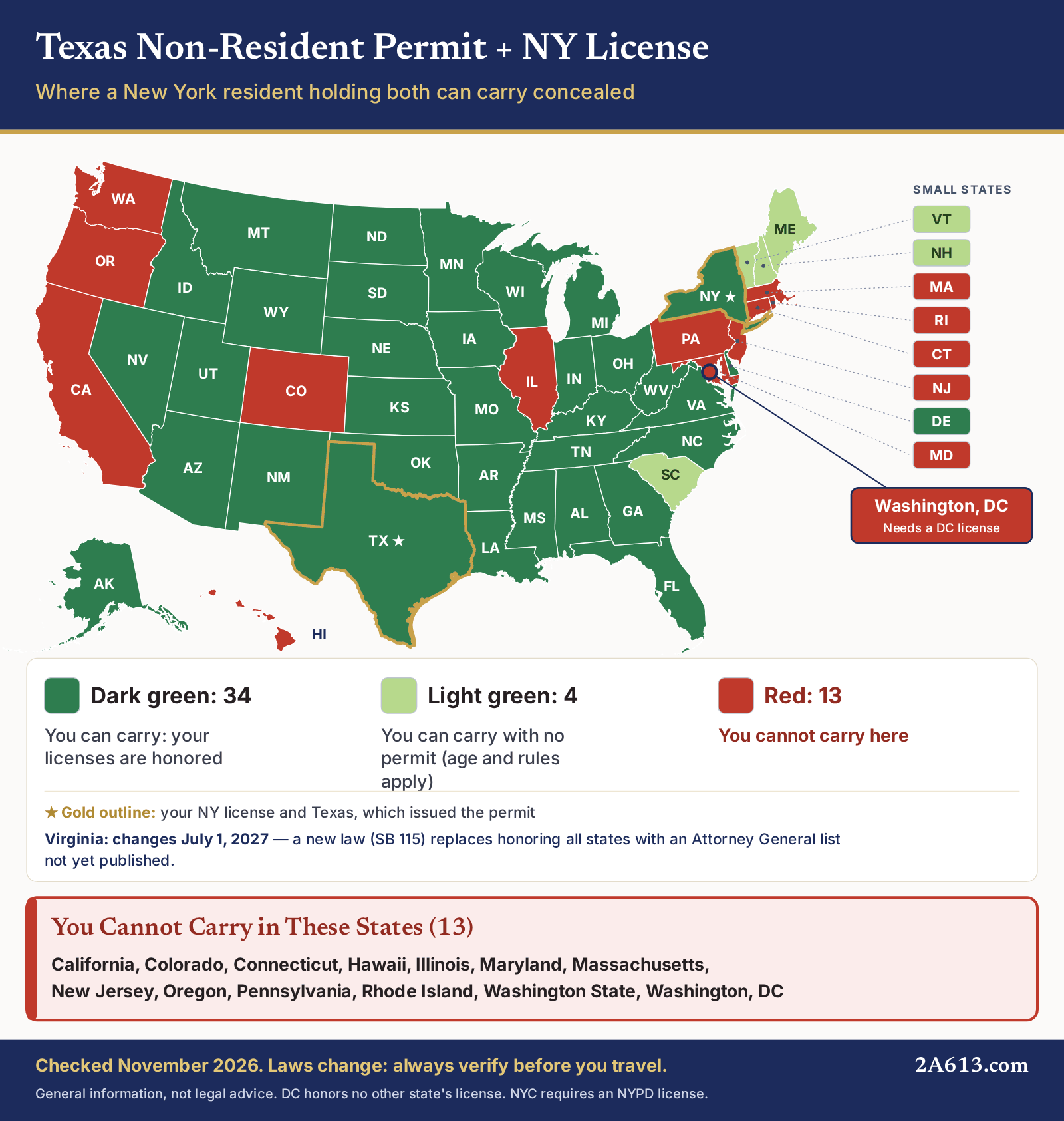
You Cannot Carry in These States (13)
California, Colorado, Connecticut, Hawaii, Illinois, Maryland, Massachusetts, New Jersey, Oregon, Pennsylvania, Rhode Island, Washington State, Washington, DC
Dark green: you can carry. Your licenses are honored there (or it is the state that issued the permit).
Light green: you can carry with no permit. That state lets visitors carry with no permit at all. Age limits and rules apply.
Red: you cannot carry here. None of your licenses is honored there, and visitors may not carry without one. Do not carry.
Washington, DC does not recognize any other state's license — you need a DC Concealed Carry Pistol License.
Virginia: changes July 1, 2027 — a new law (SB 115) replaces honoring all states with an Attorney General list not yet published.
Before You Travel
- Check every state on your route. Read the official state police or attorney general website for each state you will pass through. Laws change, and this map can fall behind.
- Verify your exact permit type is honored. Many states honor only permits issued to residents of the issuing state, not non-resident permits.
- Resident vs. non-resident rules differ. A state may treat the same permit differently depending on where you live.
- Permitless carry has limits. Some permitless-carry states allow it only for their own residents, or only from a certain age.
- Review each state's carry laws. Know where carry is banned (schools, government buildings, bars, parks, transit and more) and the rules for carrying in a car.
- Duty to inform. Some states require you to tell a police officer right away that you are carrying.
- Ammunition. Some states restrict hollow-point ammunition (for example, New Jersey). Check what you may carry.
- Magazine capacity. Magazine limits differ by state.
- Type of firearm. Some places ban certain firearms (for example, AR-style rifles are not allowed in New York City).
- Interstate travel (safe passage). Under federal law, 18 U.S.C. § 926A (part of the Firearm Owners Protection Act of 1986, signed by President Reagan), you may transport a firearm through a state where you cannot legally carry, if you may lawfully possess and carry it at both your starting point and your destination. The firearm must be unloaded, and neither the firearm nor any ammunition may be readily accessible from the passenger compartment: keep them in the trunk, or, in a vehicle without a trunk, in a locked container other than the glove compartment or console. Stops along the way can complicate this protection, so verify before you travel. Read 18 U.S.C. § 926A
Checked November 2026. Laws change: always verify before you travel. This is general information, not legal advice.
Last checked: November 1, 2026
New to the terms? See the 2A Glossary.

You Carry the Responsibility. We Carry the Process.
The decision to carry is yours. The stress of getting approved doesn't have to be. White Glove is a full service: we handle the process with you, make sure every requirement is met 100%, and stay with you to the finish line. Every completed application we've handled has been approved.
- Full service - we take the stress of doing it all
- Every requirement checked and met, 100%
- We Prepare and Submit All Your Paperwork
- Notary services available*
- Your 18-hour training scheduled
- We Prep You for the Fingerprinting and Interview Appointment
- Guided step by step - and We Assist You Once You're Approved
Join the 2A613 Community
Take our community survey and subscribe to updates. We only email about important topics and never sell your email to third parties.
Take the survey