

Resources
Gun Safety
Quick GlanceThe four rules of gun safety, the everyday habits that go with them, and how to keep your home safe: storage, talking to kids, visitors, and suicide prevention.
Every safe gun owner follows the same four rules, every time, with every gun. Learn them until they are automatic, then make your home just as safe for the people you love.
The Four Rules of Gun Safety
These are known as The Four Rules. If you follow all four, an accident would take more than one mistake.
1Treat Every Gun as If It Is Loaded
Even if someone just told you it is empty, and even if you saw it unloaded a minute ago. Check it yourself every time you pick it up or someone hands it to you. Never assume.
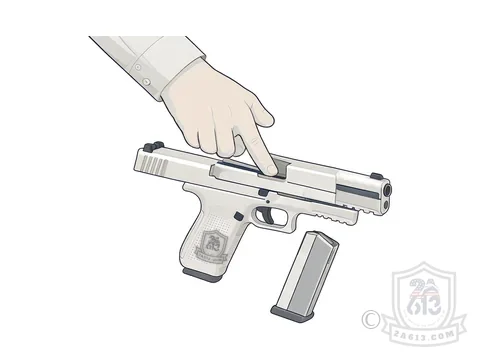
2Never Point It at Anything You Are Not Willing to Destroy
Always keep the muzzle pointed in a safe direction: usually down, or downrange at the range. This is called muzzle discipline. It applies when you clean, when you holster, and when you hand a gun to someone.
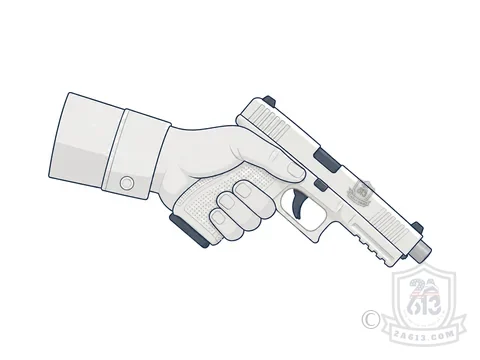
3Keep Your Finger Off the Trigger Until You Are Ready to Shoot
Rest your finger straight along the side of the frame, outside the trigger guard. It goes on the trigger only when your sights are on the target and you have decided to shoot. This is called trigger discipline.

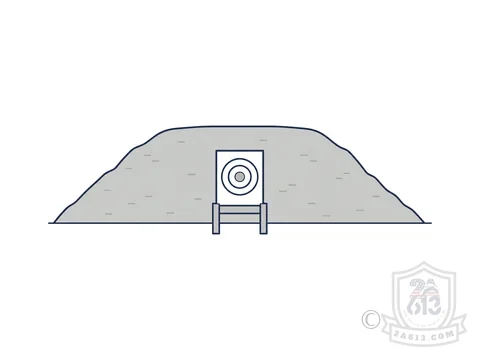
4Know Your Target and What Is Beyond It
A bullet can go through or past what you are aiming at. Be sure of what you are shooting at, what is behind it, and what is around it. At the range, that is what the backstop or berm is for.
Everyday Safety Habits
Check it yourself. When you pick up a gun, or someone hands you one, check that it is unloaded before you do anything else with it.
Hand a gun over open and empty whenever you can, with the action open and the magazine out.
Use only the correct ammunition for your gun. The right caliber is marked on the barrel or slide.
Never mix guns with alcohol, drugs or medicine that makes you drowsy.
Wear eye and ear protection whenever you shoot.
Holster with care. Keep your finger out of the trigger guard and your clothing out of the holster. See our Holsters and Carry guide.
If a gun does not fire when you press the trigger, keep it pointed in a safe direction, wait, and then follow your training or the range officer's instructions.
Get trained. A good class is the fastest way to build safe habits. See our Training page.
Safety at Home
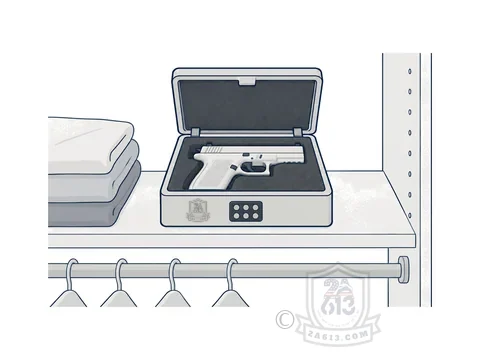
Lock it up. A gun that is not on you or under your direct control should be in a gun safe, a lock box, or have a gun lock.
A quick-access safe by the bed or in a closet keeps a home-defense gun ready for you, and locked away from everyone else.
Keep keys and codes private. Children are very good at finding hidden keys and watching you type a code.
Store ammunition locked as well, especially if children live in or visit your home.
When you take your carry gun off at night or when you get home, put it straight into the safe. Don't leave it in a drawer, a coat or a bag.
Know who can get in. Think about everyone who lives in or visits your home, including teenagers, guests and workers.
Talking to Kids About Guns
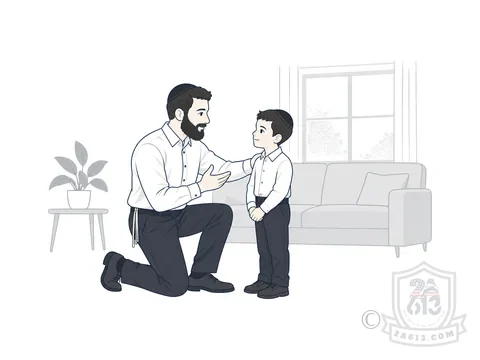
Children are curious. Locking your guns up is the first layer of safety. Teaching your children what to do is the second, because they may find a gun somewhere else: at a friend's house, in a park, or on the street.
Start early, in simple words, and repeat it often. Ask them to tell it back to you.
Explain that real guns are not toys, and that guns on TV and in games are pretend. Real guns can hurt people.
Make it OK to tell you. Praise them for telling an adult, even if they touched it first.
Answer their questions. Curiosity fades when it is answered. Some parents choose to show an older child their gun, unloaded and under supervision, so it is no longer a mystery.
Practice. Role-play what they would do if a friend showed them a gun.
Visitors and Guests
Before guests arrive, especially guests with children, check that every gun is locked up or on you.
Guests who carry should keep their gun on them or locked in their car or a safe. A gun should never be left in a coat, a purse or a bag on the bed.
When your children visit other homes, it is fine to ask politely: "Are there guns in the house, and are they locked up?" Most parents appreciate the question.
Babysitters, cleaners and workers: assume they may open drawers and closets. Keep everything locked.
Suicide Prevention and Red Flag Laws
This is a hard subject, and an important one. If someone in your home is going through a dark time, the steps in this section can save a life.
Suicide is the largest share of gun deaths in the United States. In 2024, there were 44,447 firearm deaths, and 27,593 of them were suicides: about 6 in 10.(*)Source: CDC, National Center for Health Statistics: Suicide FastStats and Injury FastStats (2024 data) · checked 11/2026 Most people who use a gun in a suicide attempt do not survive.(*)Source: CDC: Firearm Injury and Death, Fast Facts · checked 11/2026 The CDC lists easy access to lethal means, such as a gun, as a risk factor for people at risk of suicide.(*)Source: CDC: Risk and Protective Factors for Suicide · checked 11/2026 Putting time and distance between a person in crisis and a gun is one of the most important things a family can do.
If someone in your home is struggling, act now. You do not need to wait for a crisis.
Free, Confidential Help, 24/7
988 Suicide & Crisis Lifeline
Call or text 988, or chat at 988lifeline.org.(*)Source: 988 Suicide & Crisis Lifeline (official site) · checked 11/2026
Veterans and Service Members
Dial 988, then press 1, or text 838255. You don't need to be enrolled in VA benefits or health care.(*)Source: Veterans Crisis Line (U.S. Department of Veterans Affairs) · checked 11/2026
Crisis Text Line
Text HOME to 741741.(*)Source: Crisis Text Line (official site) · checked 11/2026
Immediate Danger
If someone's life is in danger right now, call 911.
Practical Steps for Your Home
Move the guns out of the home for now. Ask a trusted person, or a gun shop (FFL) that offers storage, to hold them until things are better. Transfer laws vary by state. In New York, a private transfer must go through a licensed dealer unless it is between immediate family (spouses, domestic partners, children and stepchildren).(*)Source: NY General Business Law § 898 · checked 11/2026 New Jersey has a similar dealer rule, with its own family exceptions.(*)Source: N.J.S.A. 2C:58-3 (P.L.2018, c.36) · checked 11/2026 Check your state's rules before you hand a gun to anyone.
If the guns stay home, lock every one of them in a safe or lock box, and change the code or move the key so the person at risk cannot get to it. Out of sight or out of reach is not the same as locked.(*)Source: CDC: Suicide Prevention, “Store firearms and medications securely” · checked 11/2026
Add extra locks. A cable or trigger lock on a gun inside a locked safe adds one more step.
Store ammunition separately, locked, in a different place from the guns.
Lock up medications too, and reach out: you can call or text 988 as a worried family member, not only when you are in crisis yourself.
For the storage rules in your state, see our Safe Storage and Travel guide.
Red Flag Laws (Extreme Risk Protection Orders)
A “red flag” law lets a judge temporarily stop a person who is a danger to themselves or others from having or buying guns. The legal name is usually an Extreme Risk Protection Order (ERPO), though some states use other names.
By our count of state laws, as of November 2026, 22 states and the District of Columbia have a red flag law (there is no single official government list). Maine is the newest; its law took effect in February 2026.
See all 22 states and D.C.
California: Gun Violence Restraining Order(*)Source: Cal. Penal Code § 18100 and following · checked 11/2026
Colorado: Extreme Risk Protection Order(*)Source: C.R.S. § 13-14.5-101 and following, added by HB19-1177 (signed bill, Colorado General Assembly); Colorado Judicial Branch: ERPO forms · checked 11/2026
Connecticut: Risk Protection Order(*)Source: Conn. Gen. Stat. § 29-38c · checked 11/2026
Delaware: Lethal Violence Protective Order(*)Source: 10 Del. C. § 7701 and following · checked 11/2026
District of Columbia: Extreme Risk Protection Order(*)Source: D.C. Code § 7-2510.01 and following · checked 11/2026
Florida: Risk Protection Order(*)Source: Fla. Stat. § 790.401 · checked 11/2026
Hawaii: Gun Violence Protective Order(*)Source: HRS § 134-61 and following · checked 11/2026
Illinois: Firearms Restraining Order(*)Source: 430 ILCS 67 (Firearms Restraining Order Act) · checked 11/2026
Indiana: Court warrant to seize guns from a person found “dangerous” (police apply; often called the Jake Laird Law)(*)Source: Ind. Code ch. 35-47-14 (Seizure and Retention of a Firearm) · checked 11/2026
Maine: Extreme Risk Protection Order (in effect Feb. 2026)(*)Source: 25 M.R.S. § 2241 and following (see § 2244) · checked 11/2026
Maryland: Extreme Risk Protective Order(*)Source: Md. Code, Public Safety § 5-601 and following · checked 11/2026
Massachusetts: Extreme Risk Protection Order(*)Source: M.G.L. c. 140, § 131R and following · checked 11/2026
Michigan: Extreme Risk Protection Order(*)Source: MCL § 691.1801 and following (Act 38 of 2023) · checked 11/2026
Minnesota: Extreme Risk Protection Order(*)Source: Minn. Stat. § 624.7171 · checked 11/2026
Nevada: Order for Protection Against High-Risk Behavior(*)Source: NRS 33.500 and following · checked 11/2026
New Jersey: Extreme Risk Protective Order(*)Source: N.J.S.A. 2C:58-20 and following (P.L.2018, c.35) · checked 11/2026
New Mexico: Extreme Risk Firearm Protection Order(*)Source: NMSA 1978 § 40-17-1 and following (NM Courts) · checked 11/2026
New York: Extreme Risk Protection Order(*)Source: N.Y. CPLR Article 63-A (§ 6340 and following) · checked 11/2026
Oregon: Extreme Risk Protection Order(*)Source: ORS 166.525 to 166.543 · checked 11/2026
Rhode Island: Extreme Risk Protection Order(*)Source: R.I. Gen. Laws § 8-8.3-1 and following · checked 11/2026
Vermont: Extreme Risk Protection Order(*)Source: 13 V.S.A. § 4051 and following · checked 11/2026
Virginia: Substantial Risk Order(*)Source: Va. Code § 19.2-152.13 and following · checked 11/2026
Washington: Extreme Risk Protection Order(*)Source: RCW 7.105 (see 7.105.100) · checked 11/2026
New York
New York's law is in the Civil Practice Law and Rules, Article 63-A. A petition can be filed by police or a district attorney, a family or household member, a school administrator, or a licensed health care professional (such as a doctor, nurse, psychologist or social worker) who treated the person in the last six months.(*)Source: N.Y. CPLR § 6340 (who may petition) · checked 11/2026 A final order can last up to one year.(*)Source: N.Y. CPLR § 6343 (final order, up to one year) · checked 11/2026
If you live with someone who is under a temporary or final order, New York law says you must keep your own guns locked in a safe storage container, or locked with a gun lock, whenever they are not in your immediate possession or control.(*)Source: NYS Penal Law § 265.45 · checked 11/2026
Separately, a mental health professional who is treating someone and believes the person is likely to seriously harm themselves or others must report it. That report can lead to the person's gun license being suspended or revoked.(*)Source: NY Mental Hygiene Law § 9.46 · checked 11/2026
New Jersey
New Jersey's law (P.L.2018, c.35) lets a family or household member, or police, ask the court for a temporary order. A hearing for a final order must be held within 10 days, and a final order stays in effect until a judge ends it. Either side can ask the court to end it at any time.(*)Source: P.L.2018, c.35 (N.J.S.A. 2C:58-20 to 2C:58-32) · checked 11/2026
Connecticut
Connecticut has had a risk protection order law since 1999. Police or a prosecutor can apply, and a family or household member or a medical professional can ask the court to start an investigation. A hearing must be held within 14 days, and the person may first ask the court to end the order 180 days after that hearing.(*)Source: Conn. Gen. Stat. § 29-38c (P.A. 99-212, as amended) · checked 11/2026 Connecticut also requires every gun at home to be in a locked box or other secure container, or kept on you, whoever lives there.(*)Source: Conn. Gen. Stat. § 29-37i · checked 11/2026
Some states have extra storage rules when a person who lives with you may not legally have a gun. New York (above) and California are examples.(*)Source: Cal. Penal Code § 25135 · checked 11/2026 The rules are different in every state. ⚠️ Do your own research or speak to a local attorney.
This section is general information, not legal or medical advice. If you or someone you love is in crisis, call or text 988.
Storage Laws
Some states have laws about how guns must be stored, especially when children or people who may not have guns live in the home or could get to a gun. New York is one of them.(*)Source: NYS Penal Law § 265.45 · checked 11/2026 For what the law says in plain words, see our Safe Storage and Travel guide.
Storage rules depend on your state and sometimes your city, and they change. ⚠️ Do your own research or speak to a local attorney.
This page is general information, not legal advice.
New to the terms? See the 2A Glossary.
To be accepted into our chats: after tapping Join, send us a message through the Contact Us page, choose “Join WhatsApp Groups Request”, then reply to the automatic email with all the requested details.
Your Application, Handled From Start to Finish.
One-on-one help with new applications and renewals. The decision to carry is yours; the paperwork, the checklists and the scheduling are ours.
- We Prepare the PaperworkEvery form filled out and submitted for you, with your authorization. Notary services available.*
- We Check Every DocumentEvery requirement checked before anything goes in.
- You Show Up ReadyYour 18-hour training scheduled, and you're prepped for fingerprinting and the interview.
Three Steps. Zero Guesswork.
- 1Tell Us What You NeedFill out the short request form.
- 2We Review & AdviseWe review your situation and advise on the best approach.
- 3You Apply With ConfidenceYour packet goes in complete, and we stay with you to the finish line.
Every completed application we've handled so far has been approved — but approval is always the agency's decision.
Or message us on WhatsAppA paid service. Every free guide stays free. The initial consultation is free. No paid work starts until you agree to the quote and a paid deposit, which is determined during the initial consultation. *Additional fees and restrictions apply. Past results do not guarantee future approval.
Join the 2A613 Community
Take our community survey and subscribe to updates. We only email about important topics and never sell your email to third parties.
Take the surveyLast updated: 11/07/2026 · כ״ז חשון תשפ״ז