

Resources
Police Stop While Carrying
Quick GlanceWhat to do if police stop you while you are carrying: stay calm, keep your hands where they can be seen, and know when the law says you must tell the officer.
Most police stops are routine: a broken taillight, a rolling stop, a quick question. When you are carrying, a few simple habits keep the stop calm and short, for you and for the officer.
The Basics: Calm, Hands, Words
The officer walking up to you does not know who you are yet. Everything you do in the first minute should make it easy for them to see that you are calm, cooperative and not a threat.
Stay calm and polite. Speak slowly and clearly. A calm voice helps the officer stay calm too.
Keep your hands where they can be seen, open and empty.
No sudden moves. Don't reach for your wallet, the glove box, a bag or your waistband until you have said what you are reaching for and the officer says it is OK.
Never touch your gun. Not to adjust it, not to show it, not to hand it over. If the officer wants to secure it for the stop, let them tell you exactly how, or let them take it.
Follow instructions, even if you think the stop is a mistake. The roadside is not the place to argue. That is what courts and complaint offices are for.
Be honest. If an officer asks whether you have a gun, tell the truth. In several states, not answering truthfully is a crime.(*)Examples: A.R.S. § 13-3102(A)(1)(b), Arizona Legislature; Ohio R.C. 2923.12(B)(1) · checked 11/2026
Keep your carry license or permit together with your driver's license or ID, in a wallet on the side away from your gun.
In the car, keep your registration and insurance card somewhere easy to reach that is not where your gun is, for example a visor clip instead of the glove box.
Practice the words you would say (see What to Say), so they come out naturally.
In Your Car
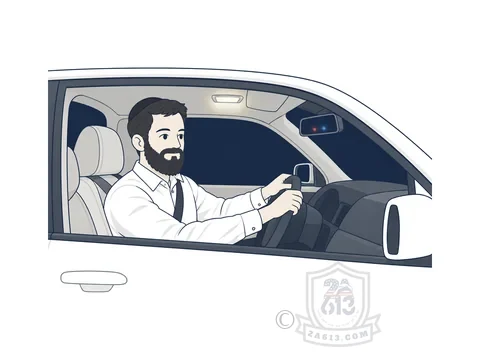
A traffic stop is one of the most dangerous things a police officer does, along with domestic violence calls. Officers walk up to the car tense, often with a hand on or near their service weapon. They are not drawing it, just staying ready, because they never know who is in the car. Every step below shows the officer that you are not trying to run or hide, so they feel safer as they approach and the stop stays calm.
Most stops of people who carry happen on the road. When you see the lights behind you:
Signal and pull over all the way to the right as soon as it is safe, unless the officer tells you otherwise. Stop in a well-lit spot if you can.
Turn off the engine and put the keys on the dashboard.
If it's dark, turn on the interior (dome) light so the officer can see inside the car.
Roll down your window all the way. If you have tinted windows, roll down all the windows.
Put both hands on the steering wheel at the 10 and 2 o'clock position, the most visible spot, and keep them there. Passengers keep their hands in plain view too, for example on their knees or on the dashboard.
Stay in the car unless the officer tells you to get out.
Don't start digging for papers before the officer asks. When they ask, say where each item is and where your gun is, then move slowly.
If your gun is in the glove box or console, say so before you open it, and ask the officer how they would like you to proceed.
From experience: when you follow these steps and stay calm, polite and respectful with the officer, for minor things (a few miles over the limit, a forgotten turn signal) officers often let you go with a warning instead of a ticket. That's not a guarantee, but it helps.
Getting out of the car is when holsters get bumped and shirts ride up. If the officer asks you to step out, first tell them where your gun is, so nothing is a surprise.
On Foot
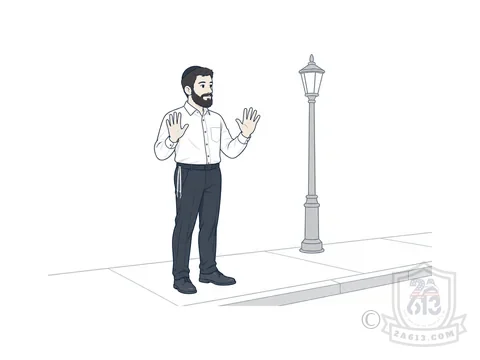
Stop and face the officer, with your hands open and away from your body.
Keep your hands out of your pockets and away from your waistband, even to pull up your pants or fix your shirt.
If your state requires it, or if you choose to, tell the officer early that you are carrying and where the gun is.
If the officer asks for ID, say where it is and where your gun is before you reach.
If you are told to raise your hands, turn around or stand still while the officer secures the gun, do exactly that, and don't try to help unless asked.
What to Say
Keep it short and calm. Many carriers say "firearm" rather than "gun", and never say it suddenly or loudly. Something like:
"Good evening, officer. I want to let you know I have a carry license and I'm carrying. My firearm is on my right hip. My license and ID are in my wallet in my left back pocket. How would you like me to proceed?"
Today, almost every officer has a body camera on. Everything you say is recorded and can be used against you in court. Be careful with your words: stay calm and polite, and stick to plain facts. Don't guess or explain more than you need to. Talk with an attorney ahead of time about what to say and what not to say at a stop.
When to Tell the Officer
Where the law requires it (see the list below), tell the officer right away, as soon as they come to you, before anything else.
Where it is not required, many carriers still choose to say it early, together with their license. It usually makes the stop smoother, and it avoids a surprise if the officer sees the gun or your license.
Either way, if the officer asks whether you have a gun, answer truthfully.
What you must say, which questions you have to answer, and whether you may decline a search can depend on the state and the situation. ⚠️ Do your own research or speak to a local attorney.
Duty to Inform: State by State
A duty to inform law requires you to tell an officer that you are carrying. The rules differ a lot from state to state. Here is a short summary, taken from the state data on our Reciprocity Map:
If your state has a duty to inform, telling the officer is the law. It is not optional, so do it.
Alaska, D.C., Hawaii, Louisiana, Michigan, Nebraska, New Jersey, North Carolina, Oklahoma. When you are stopped or approached, say right away that you are carrying.(*)Sources: Alaska AS 11.61.220(a)(1)(A); D.C. Code § 7-2509.04(d); Hawaii HRS § 134-9.2; Louisiana R.S. 40:1379.3(I)(2); Michigan MCL 28.425f(3); Nebraska Rev. Stat. § 28-1202.04; New Jersey N.J.S.A. 2C:58-4.4(b); North Carolina G.S. 14-415.11(a); Oklahoma 21 O.S. § 1290.8 · checked 11/2026
Alabama, Arizona, Illinois, Ohio. If the officer asks whether you are carrying, you must say so. Arkansas and Texas: when the officer asks for your ID, show your carry license with it (in Arkansas, also say you have a handgun).(*)Sources: Alabama Code § 13A-11-95; Arizona A.R.S. § 13-3102(A)(1)(b); Illinois 430 ILCS 66/10(h); Ohio R.C. 2923.12(B)(1); Arkansas 5 CAR § 1-201(c); Texas Gov't Code § 411.205 · checked 11/2026
Maine: carrying without a permit, tell the officer right away; with a permit, show it if asked. North Dakota: carrying without a permit, say so if the officer asks; with a permit, show it if asked.(*)Sources: Maine 25 M.R.S. § 2003-A and § 2003(11); North Dakota N.D.C.C. § 62.1-04-04 · checked 11/2026
California and Massachusetts. California law has no rule to tell first, but you must show your license when asked, and county licenses can add their own conditions, so read yours. Massachusetts changed its law in 2024, and we have not found a current statewide rule.(*)Sources: California Penal Code § 26200; Massachusetts G.L. ch. 140 § 129C (amended 2024) · checked 11/2026
All other states. No state law requires you to tell the officer first. Many of these states do require you to carry your permit with ID and show them when an officer asks, Colorado and New Mexico among them.(*)Examples: C.R.S. § 18-12-204(2) (CBI copy); 10.8.2.16(D) NMAC · checked 11/2026
For each state's rule and the law behind it, open the Duty to Inform, Magazines and Rest Stops card on our Reciprocity Map.
Duty-to-inform rules can depend on whether you are driving, a passenger or on foot, whether you hold that state's permit or carry without one, and on city or county rules. They also change. ⚠️ Do your own research or speak to a local attorney.
New York and New Jersey
New York
New York has no law that requires you to tell an officer first. But you must have your license on you whenever you carry, and you must show it to any police officer who asks.(*)Source: N.Y. Penal Law § 400.00, NY State Senate · checked 11/2026 Many New Yorkers still tell the officer early, with their license, to keep things simple.
Inside New York City you need an NYPD license (a license from another New York county is not valid in the city). See our NYC guide.
New Jersey
If you hold a New Jersey permit to carry and you are stopped or detained while carrying in public, or while traveling with a handgun in your car, you must:
Immediately tell the officer that you are carrying a handgun, or that a handgun is in the vehicle, and
Show your permit to carry.
Not telling the officer is a fourth-degree crime. If you are detained as part of a criminal investigation, you must also let the officer inspect the handgun if they ask.(*)Source: N.J.S.A. 2C:58-4.4 (P.L.2022, c.131, § 5), NJ Legislature · checked 11/2026
See our New Jersey non-resident guide and New Jersey resident guide.
Special carry licenses, premises licenses and the conditions printed on a license can add their own rules. ⚠️ Do your own research or speak to a local attorney.
After the Stop
If the officer held your gun during the stop, let them return it the way they choose. Don't reholster or reload it until the officer has left, and only when it is safe to do so.
If you got a ticket, take it calmly. You can deal with it later, in court if needed.
If you think something went wrong, stay polite now. Write down the officer's name, badge number, and the time and place as soon as you can, and speak to an attorney.
Drive away slowly once the officer says you are free to go.
Traveling to another state? Before you go, check where your permit is honored and how to carry in a car there: see our Reciprocity Map and Safe Storage and Travel guide.
This page is general information, not legal advice.
New to the terms? See the 2A Glossary.
To be accepted into our chats: after tapping Join, send us a message through the Contact Us page, choose “Join WhatsApp Groups Request”, then reply to the automatic email with all the requested details.
Your Application, Handled From Start to Finish.
One-on-one help with new applications and renewals. The decision to carry is yours; the paperwork, the checklists and the scheduling are ours.
- We Prepare the PaperworkEvery form filled out and submitted for you, with your authorization. Notary services available.*
- We Check Every DocumentEvery requirement checked before anything goes in.
- You Show Up ReadyYour 18-hour training scheduled, and you're prepped for fingerprinting and the interview.
Three Steps. Zero Guesswork.
- 1Tell Us What You NeedFill out the short request form.
- 2We Review & AdviseWe review your situation and advise on the best approach.
- 3You Apply With ConfidenceYour packet goes in complete, and we stay with you to the finish line.
Every completed application we've handled so far has been approved — but approval is always the agency's decision.
Or message us on WhatsAppA paid service. Every free guide stays free. The initial consultation is free. No paid work starts until you agree to the quote and a paid deposit, which is determined during the initial consultation. *Additional fees and restrictions apply. Past results do not guarantee future approval.
Join the 2A613 Community
Take our community survey and subscribe to updates. We only email about important topics and never sell your email to third parties.
Take the surveyLast updated: 11/07/2026 · כ״ז חשון תשפ״ז